Norton's Ghost

His world thrown into doubt with the death of his father, Kyle Dearmond takes to hitchhiking, where he finds meaning, friends, and a new direction despite the chaos of the wandering road.
His father’s passing and subsequent will shed new light on the death of his mother years before. But the will raises more questions than it answers and no one seems to know the whole story.

Unsure where his life is going but almost certain it isn’t going back to being a college student, he takes his losses with him as he hits the road. Kyle travels with and learns from those who call the road home on purpose and the homeless who have fallen through the system.

Round Ireland With A Fridge

Whilst in Ireland for an International Song Competition, Tony Hawks was amazed to see a hitch-hiker, trying to thumb a lift, but with a fridge. This seemed amazingly optimistic - his Irish friends, however, thought nothing of it at all.

"I had clearly arrived in a country", writes Tony, "where the qualification for ‘eccentric’ involved a great deal more than that to which I had become used". Years pass... but the fridge incident haunts our author.

Until one night, heavy with drink, he finds himself arguing about Ireland with a friend. It is, he insists, a "magical place", so magical in fact, that a man could even get a lift with a fridge.

The Hitchhiking Grandmother

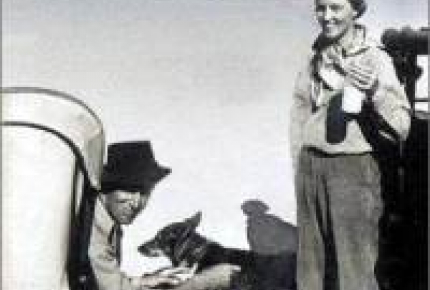
Grace Small born in 1895 and known as the 'Hitchhiking Grandmother', began hitchhiking in the 1940, at the age of 51 years.

She hitchhiked for 27 years, crossing the United States at least 19 times with 10 trips through the west coast alone. She also hitched through Europe in 1964 while in her late 60s. Stories of her were written in many newspapers. Her hitchhiking attire was a 'a proper suit, hat and gloves.'

Her story is told by author Ruth Barton Davis in the book, "The Hitchhiking Grandmother." Written from Grace's first-person view, it recounts her life as a small child all the way up to her 'retirement' from hitchhiking after the age of 90.

Into the Wild

Immediately after graduating from college in 1991, Alex roams through the West and Southwest in the United States on a vision quest. In the Mojave Desert he abandons his car, strips it of its license plates, and burns all of his cash. Officially named Christopher Johnson McCandless, he also gives himself a new name, Alexander Supertramp.
Alex travels for more than two years before he goes to live in the wild, without the advents of human society. Living in a bus in the midst of the Alaskan wilderness with nothing more than some basic supplies, he keeps a careful diary of his time, his thoughts, and his reasons for fleeing from society.

Over a hundred days later, hunters find McCandless’s body partially decomposed in the bus, the diaries and meager supplies still nearby.

Hand to Mouth to India

Tom wrote Hand to Mouth to India in 1997/8 at the age of 20. It tells of the journey he made hitchhiking from England to India with no money. He was full of the tales of the East where sadhus, sufis and mystics trust themselves to the Fates and wanted to see if it was possible in a modern day and age.
The book became his badge, his freak credentials for a while and the image of the impoverished traveler was one he wore for perhaps a little too long. It's a book of a young man with a few chips on his shoulder and a knapsack full of spiritual ideas which he was a little young to understand. Still, the journey was no mean feat and he learnt a lot along the way- even if it did take him years to understand exactly what.

Hitching Rides with Buddha

Take a humorist from the Great White North — one part Bob and Doug McKenzie, the other Bill Bryson — feed him lots of sake, and set him loose hitchhiking his way through polite Japanese society. The result is one of the warmest and funniest travelogues you've read.
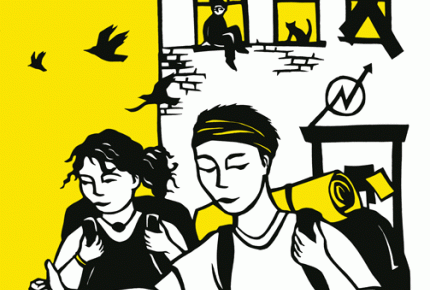
It had never been done before. Not in four thousand years of Japanese recorded history had anyone followed the Cherry Blossom Front from one end of the country to the other. Nor had anyone hitchhiked the length of Japan. And, as Ferguson learns, it illustrates that to travel is better than to arrive.

Off The Map

A punk rock vision quest told in the tradition of the anarchist travel story, Off the Map is narrated by two young women as they discard their maps, fears, and anything resembling a plan, and set off on the winds of the world.

Without the smug cynicism that seems to permeate most modern radical tales, this story is told with genuine hope, and a voice that never loses its connection with the mysteries of life, even in the midst of everyday tragedies.

Wandering across Europe, the dozens of vignettes are the details of the whole—a squatted castle surrounded by tourists on the Spanish coast, a philosophizing businessman on the highways of France, a plaça full of los crustos in Barcelona, a diseased foot in a Belgian train squat, a glow bug on the dew-covered grass of anywhere—a magical, novel-like folktale for the end of the world.